

Esther Fradel Schwartz is a senior Hidden Sparks coach and mentor. She holds a Bachelor’s Degree in interdisciplinary studies from Touro College and a Masters of Science in Education from the College of Staten Island CUNY. Before becoming a coach in 2010, Mrs. Schwartz gained twelve years of teaching experience in early childhood and special education classrooms and was an adjunct professor of education at Daemen College. She also coordinated the Mishan Letalmid and Shutfim: Parent Partners programs for Toshia, providing assistance to parents and teachers of children with learning and behavioral challenges. Mrs. Schwartz is the author of a popular social skills curriculum “My Place, My Space” published by Focus in Education.
This session will be a facilitated discussion to construct and deepen our understanding of working memory collaboratively. After the facilitated discussion, you can stay on to discuss students you have been observing, especially if they seem to have strengths or struggles having to do with memory (time permitting).
PREPARATION MATERIAL & OPTIONS
For each Webchat, there are 3 levels of preparation: 1) Short prep (up to 45 min.), 2) Medium prep (up to 3 hours), 3) Long prep (over 3 hours). Choose the preparation level that corresponds to the amount of time you can spend on learning before the WebChat.
Please keep the following questions in mind as you prepare for the WebChat:
- When was the last time you experienced a working memory overload and what strategies were helpful to you?
- What would a student working memory breakdown look like in real time?
- What are some examples of “missed opportunities for learning” that occur during working memory breakdowns?
Memory and The Brain (Reading)
McGill University Web site
This website has three levels of explanations about how memory works from different perspectives: social, psychological, neurological, cellular and molecular.
Please read the web pages for psychological and neurological.
http://thebrain.mcgill.ca/flash/i/i_07/i_07_p/i_07_p_tra/i_07_p_tra.html
“Understanding Working Memory: A Classroom Guide” by Susan Gathercole and Dr. Tracy Alloway (Reading)
This booklet provides an introduction to working memory and to the role it plays in everyday life, especially supporting learning in school. It describes the learning difficulties children with poor working memory face, and suggestions for supporting those students.
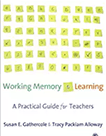 Working Memory and Learning: A Practical Guide for Teachers by Susan Gathercole and Tracy Packiam Alloway
A good working memory is critical to learning. This book explains the concept and functions of working memory and how it affects learning. It also provides practitioners with strategies for recognizing and helping students who are challenged by aspects of their working memory.
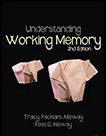 Understanding Working Memory, 2nd edition. By Tracy Packiam Alloway and Ross g. Alloway (Book) (Kindle, $28.44; paperback new $26.58, used from 30.58)
This is a clearly written and well-organized book, providing valuable information about working memory and how it can affect individuals’ learning and progress in an educational context. It is a ‘must read’ for all teachers and support assistants in primary and secondary schools. Many parents are likely to find the book of interest to them if they have a child with any of the disorders discussed in the book. Undergraduate psychology students would also benefit from reading this book as background understanding to working memory in context – the references and further reading offering opportunity to extend their knowledge. (Jenny Moody, Postgraduate Psychology Tutor, Dyslexia Action).
Selections from Educational Care by Mel Levine
Selections from Developmental Variations by Mel Levine
Selections from Keeping a Head in School by Mel Levine
http://hsparksimages.s3.amazonaws.com/webchats/DVLD_Memory.pdf
http://hsparksimages.s3.amazonaws.com/webchats/EC_memory.pdf
http://hsparksimages.s3.amazonaws.com/webchats/KHS_Memory.pdf
http://hsparksimages.s3.amazonaws.com/webchats/Classroom_guide_to_Working_Memory.pdf