

With Bianca Senker” title_size=”medlarge” el_class=”bigg”][prkwp_styled_title prk_in=”Join Us this November 13th @ 8:30PM – 9:30PM (Eastern)” title_size=”medium”][prkwp_spacer size=”18″]
Bianca Senkera coach and mentor for our Florida-based programs, holds a Master’s degree in Special Educational Leadership and is a practitioner with nearly 25 years of experience in the field of special education as a classroom teacher, inclusion specialist, coach, and consultant. She helped develop the Kesher inclusion model at The Samuel Scheck Hillel Community Day School, participated in the CAJE Project Day School of Excellence Instructional Coach Academy and served as a coach for Kesher staff, providing teacher workshops on writing pedagogy, methodology, and curriculum instruction, and differentiation. Bianca co-founded B2 Educational Therapy, which provides services for children, and during the summer, she leads a Mindful Learner’s Summer Camp Program.
This session will be a facilitated discussion to construct and deepen our understanding of social cognition collaboratively. After the facilitated discussion, you can stay on to discuss students you have been observing, especially if they seem to have strengths or struggles having to do with social cognition (time permitting).
PREPARATION MATERIAL & OPTIONS
For each Webchat, there are 3 levels of preparation: 1) Short prep (up to 45 min.), 2) Medium prep (up to 3 hours), 3) Long prep (over 3 hours). Choose the preparation level that corresponds to the amount of time you can spend on learning before the WebChat.
As you read and watch these selections, please keep these questions in mind:
1. Why is it important to take social and emotional learning into consideration?
2. What are some ways teachers can support social emotional learning in schools and classrooms?
3. Think of a student with a strength in the competency, and a student who struggles with the competency.
“Social Emotional Learning User Guide” from Panorama Education (PDF).
This booklet provides an overview of social emotional learning that includes Grit and Growth Mindset, Teacher-Student Relationships, Sense of Belonging, and School Safety. Within each of these categories, Panorama Education provides detailed rubrics that describe the social and emotional skills that are essential to academic and social success.
AND
1) “Educating a neurodiverse world” (Video, 6 min)
What kind of world would we have if we all realized what kind of mind we had and began appreciating it? What if we did the same for others? In this talk, Brian Kinghorn champions the cause of Neurodiversity, arguing that there is not just one “standard-issue” brain.
Having an Autism Spectrum diagnosis, Ph. D. candidate Brian Kinghorn advocates for greater understanding and acceptance, and reminds us that different does not have to mean less. Brian R. C. Kinghorn is pursuing a doctorate in Measurement & Evaluation at Teachers College, Columbia University. Kinghorn holds a B.S. in Mathematics from Arcadia University and an M.A. in Statistics from Columbia University. Besides scholarly pursuits and philosophical debate, Brian enjoys Mindfulness Meditation and is an Aikido practitioner.
As you’re watching these videos, think about how social emotional issues affect learning.
1. What does Goldman say about developing social emotional skills?
2. What do you have to do to make these practices second nature so that they become your preferred neuropathway?
3. Think of a student for whom the information in these videos apply.
1) “Social Intelligence” Daniel Goldman Talks at Google
YouTube Lecture (Video, 6 min)
Daniel Goldman who introduced the concept of emotional intelligence discusses his book Social Intelligence: The New Science of Human Relationships as part of the Authors@Google series, an event that took place at Google on August 3, 2007.
2) “Emotional Intelligence by Daniel Goldman, an Animated Book Summary” (Video, 6 min)
This video by OnePercentBetter illustrates and explains the key concepts from Daniel Goldman’s book Emotional Intelligence: Why It Can Matter More than IQ
As you read Aspertools please keep these questions in mind:
1. How these tools can be beneficial to a wide range of students?
2. How do you find someone’s hidden sparks when the person is really annoying you because of her lack of social skills?
3. Think of a student who might benefit from your using these tools.
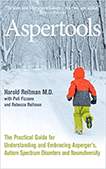 AsperTools: A Practical Guide for Understanding and Embracing Asperger’s, Autism spectrum Disorders and Neurodiversity by Harold Reitman, Pati Fizzano and Rebecca Reitman. (Book)
After reviewing the scientific community’s research, conducted over the last nearly 40 years, Dr. Reitman believes that it’s time to not just accept neurodiversity, but to embrace it, and this book will help people do just that. It is the first book to offer simple tools, action plans and resources to help understand and deal with anyone whose brain is a bit different. Our educational system, our workplaces, and society at large will no longer be one size fits all―each individual will have the opportunity to maximize their potential―and we will be the better for it.
“Social-Emotional Teaching Strategies” TK California (Web)
“21 Simple Ways to Integrate Social-Emotional Learning Throughout the Day” from We Are Teachers (Web)
“The Social Side of School” from Keeping Ahead in School by Mel Levine.
pp. 197 – 219 (PDF)
“Social Ability” from Developmental Variation and Learning Disorders by Mel Levine.
pp. 261 – 295 (PDF)
With Bianca Senker” title_size=”medlarge” el_class=”bigg”][prkwp_styled_title prk_in=”Join Us this November 13th @ 8:30PM – 9:30PM (Eastern)” title_size=”medium”][prkwp_spacer size=”18″][prk_wp_theme_button button_bk_color=”#5a3f98″ prk_in=”Reserve Your Spot, Register Now →” link=”https://zoom.us/meeting/register/429c6569cc72bfc134538d7d4481ef37 ” window=”Yes” el_class=”theme_button_inverted”][prkwp_spacer size=”28″]